You'll be missed. Your sense of humor, wisdom beyond your years, endless curiosity and combination of humility and compassion combined to create a remarkable human.
A former student of mine, JR, like many of my former students, didn't give a shit about math. She showed up and remained open minded, and did the best she could, but her heart was elsewhere. Namely, English. She was majoring in English in college and would often lament to me that she had zero hopes of ever being employable. "What do I put on my resume?" she asked recently, "Studied how to read for four years?" This had been much on her mind lately, as graduation approached. Her Facebook status of November 2, six days before she died: can’t wait to finish my degree so that i can look for jobs and tell them that i’ve been formally trained in reading books.
Some other recent posts of hers:
I found out about her death from reading another former student's post on Facebook. He wrote that he had found out, while on break at work, that one of his best friends, JR, had died. Her name went right by me and I just felt compassion for the guy. Then, many seconds later, it began to dawn on me that he was talking about JR.
Having been a teacher for more than 30 years, I have gone through the experience of young people dying many times. It always just seems impossible to me. In spite of knowing the truth of impermanence and the inevitability of death, when someone in their teens or 20's dies, it always seems surreal to me, like it was not "supposed" to happen.
Apparently, JR had a seizure that resulted in an accident that killed her. I don't know any of the other details.
She was one of the examples of why I love remaining friends with the most interesting of my former students. It's one of the great blessings of having been a teacher, especially of adolescents. I find many young people to be a lot more interesting than people my age. She embodied a lot of the reasons why that is so. There's a freshness, unfettered wisdom, strength and resilience in all of my favorite people, but especially in a lot of young people these days. It amazes me when older people judge and criticize, usually out of ignorance, the generations that are on the way up. In fact, these are decent, humane, creative, wise people, ready to change the world in their own ways. JR fit that bill perfectly.
Maybe in JR heaven, it'll be books and funny memes forever.
Another day, another mass shooting. I woke with a start at 2 a.m. and the dark air seemed alive with anxiety. The news rolls in via social media. White male with gun, unknown casualties, breaking, live, update. Nightclub. By dawn we get more detail. Body counts. Hand waving. It seems few of the messengers report the whole truth. Another. White. Male. We're collectively blind to this. Flip the script and imagine if mass shootings were being done by any member of any marginalized group. Think particularly about marginalized groups that have been demonized. The entire narrative would be different. Action would be taken. Would have been taken long ago. Few things speak to the endurance of white male privilege more loudly than the collective hypnosis that is silencing the conversation about white male terrorism. America is in a hell state now. On the one hand, a depraved leadership maliciously misleading and obfuscating. Aided and abetted by what has become a state run news agency. On the other hand, the beautiful advances toward true plurality that continue, in spite of the top down madness. An openly gay male governor. Unprecedented elections of women of color, including 19 black women judges in Texas.
It's been interesting being banned from posting on Facebook for the past few weeks, with about a week to go. I have been silenced and have had to read the timelines of my friends with none of the buffering that commenting provides. The main perception that has arisen in me is that *even white men who are trying their best to be allies* right now are as annoying and tiresome as fuck. The main pattern I see is a desire to control the narrative, even from the position of performative allyship. Many instances of a lack of listening. And these are the men who are among the best. The rest are quite simply just fucking awful. A friend of mine posted that her grandfather used to say, "when in doubt, vote for the woman." A man instantly had to comment that that was the worst idea he ever heard, because it negates all of the hard work a male candidate may have done to get on the ballot, and if you are really that misinformed, you shouldn't be voting. Predictably, the comment had 8 likes. Every single one of them male. These microaggressions each are, well, micro. But the aggregate of millions of such stances in defense of a murderous, oppressive, terrorist cis-hetero patriarchy create an aggravating, toxic climate. Add to this poisoning of discourse the white male terrorist armed with a gun, and add all the rest of the death cry of the old order, and you get a hellish picture. My perspective on all of this taken together is that it is the terrified backlash against the gynifying and browning of public life. Or even the flat out de-gendering of public life. The very concept of whiteness erodes. I am deeply grateful for this, as I think whiteness is the fiercest and most killing poison the world faces. Second to whiteness is the idea of maleness. White maleness is the sick iconography of our time. The antidote is women in power, and people of color in public positions. I don't long for the mainstreaming of women of color and other marginalized groups. But for the marginalization of white men, and especially for the death of the power prejudice of old white cis male leadership, even the "benign" kind of the old white cis male Democrat. And for the emergence of a true pluralism through which the vast diversity of American experience can find power and representation. I fear that this shift, which is inevitable, will be agonizing along the way. Iconographies entrenched for thousands of years don't just stand up and applaud when the paradigm changes. Fuckers get psycho.
Everybody's sayin' that hell's the hippest way to go, well I don't think so, but I'm gonna take a look around it though...
An emotional mentor of mine, Joni Mitchell, 75 years old today. Back in the winter of 1983, as I experienced a brutal break up with a woman who was 2000 miles away, a friend of mine was astonished to hear that I wasn't very familiar with Mitchell's perfect masterpiece, Blue, released when Mitchell was 28. Of course it hit me like a tidal wave and has stayed with me ever since, although there are times I can't even get close to it, because of what it still does to me. My sister used to listen to it up in her garret of a room in our childhood home, and my father would roll his eyes and be exasperated and say "why does she listen to that gloomy stuff?" Particularly amusing to me every year is that River is included in shopping mall and restaurant muzak rotations. The song sometimes sends me to the darkest forest, where a lot of the medium sturdy branches come equipped with rope. But then, so does Christmas, a lot of the time, for reasons I continue to try to sort out.
Also amusing and aggravating is that people have had the gall to cover many of these songs. I have only heard one person get close to a suitable cover, and that's Prince's truncated version of A Case of You. The measure of the total lack of original talent or vision, combined with what must be blinding narcissism that makes accurate self-appraisal impossible, is revealed when lesser lights have the temerity to not only attempt covers of songs like these but also publicly release them. ANYway, Mitchell's 75th birthday today has me reflecting a little bit on a range of topics: sentiment, sentimentality, memory, grief, catharsis, self pity, wallowing, romantic love, heartbreak, bitterness, cynicism, armor, "healthy" relationship, codependency versus legit attachment, unskillful avoidance versus skillful avoidance, etc. Just a few things. haha, etc. "All romantics meet the same fate someday, cynical and drunk and boring someone in some dark café." I know I certainly did. I think one of the stabbing daggers of late stage alcoholism for me was romantic disillusionment and cynicism. It may be true that the most acidulous cynics are originally the fiercest idealists. But the dark kernel inside idealism is narcissism that has nothing to do with love of an actual other human being. That I could have been reduced to snarky ash by not getting what I wanted when I wanted it from women I supposedly loved is very revealing. The passage, which became even more stark in sobriety, was from a two dimensional selfish narcissistic romantic love to the realization that love in action actually means something. It's not sentiment alone but is also generosity of spirit, unconditionality to whatever degree is possible, and an open mind. As people often say in Alcoholics Anonymous, "I didn't have partners, I took hostages." Having grown in some of those ways, I am still a romantic and still highly sentimental. An object like a hair tie sets off Proust-level cascades of romantic memory. The loml seems amused by this sometimes. We both know I'm EXTRA. Like, extra af. A friend of mine asked recently, why are you Beyoncé always? haha. It helps defuse the intensity of my waves of sentiment to have a bit of a sense of humor about it and to have advisors and friends who remind me I have other places I can put my feet. I don't regret being sentimental though. Joni Mitchell wrote the songs on Blue as a way of not dying from the legit pain she was in. I honestly believe this. Those of us who are romantics after all of this know the feeling that romantic loss will kill us. We may be tougher, have more inner resources for safe grieving and self care, but the hatchet to the heart is always a possibility. It could be one of the more profound differences between me and the loml, this fundamental romanticism. Or it may be that I don't always understand the kind of romantic values and attachments the loml experiences. It's funny from the standpoint of astrology that we are both earth, but that her earth sign is the one famous for emotional zero. Or at least, incredible emotional reserve. Is it always this way or almost always in partnerships? One person carries structure, the other person carries sentiment? Probably not always, but often, and I imagine the roles shift as well. I know the loml experiences emotional intensity around our experience, but I don't always get it, because her style is quite different from mine. I think. At any rate, when all is said and done, I am egoistically proud to have fallen in love again. After all of this. After the immolation that was the total catastrophe of the breakup with A. (haha, te dramas!). After Joni's Blue having been the soundtrack so many times, either legitimately or wallowingly, yes, I turned wallowing into an adverb, tyvm. However, I feel like the great insight that love is real in action and that the call is to be loving without regard to whether one gets what one wants or not, is a true turning point. The bitterness of the disillusionment of romanticism is a logical consequence of being a narcissistic idealist "in love with" an impossible fantasy. The object of that kind of love inevitably proves to be human and disappointing. The plunge into the general snark that one hears these days about romantic love is natural and understandable. But the way out, if one continues through, follows the red thread, and pays attention to one's true nature as a lover, is unconditionality. Growing up and loving a real actual other person, and remembering that, while the sentiment of love is grand, the action of love is the best of all. This is the way the phoenix of the romantic rises from the bitter ash of heartbreak. If the romantic is to arise at all. Not cynical, not drunk. Maybe still boring someone, over a San Pelligrino, in some dark café. But the gorgeous wings grow from not staying in the dark. Risking, and risking again, the real experience. The great sad love song singers know this. The daggers bleed us out but not to death.
This weekend, remembering a former student of mine who died of a drug overdose this year, remembering Cecil Taylor, remembering my friend JO who was shot and killed, remembering Jamal Kashoggi who met an end impossible to imagine in its horror and suffering at the hands of the most "confused and unskillful" among us ("confused and unskillful" is the interesting euphemism used by some Buddhists to explain evil human behavior-- more on that another time). Remembering some of my favorite musicians who died-- Sonny Fortune, Otis Rush, Randy Weston, Aretha Franklin, Tomasz Stańko, Glenn Branca, John Jabo Starks, Buell Neidlinger, Leon Ndugu Chancler, Hugh Masakela, Dolores O'Riordan.
Even though it was only maybe in the mid-50's a couple nights ago, I lit a ritual fire, burned some dried roses I had, wrote a few things on paper, burned the paper. I hardly used the little firepit I bought last winter, but maybe I'll use it more this year.
Of the above musicians, besides Mr. Cecil Percival Taylor of course, the one who stands out for me today is Sonny Fortune, who had a brief tenure with Miles Davis in his acid funk rock band of 1975, and ended up on both Agharta and Pangaea, as well as Get Up With It and a few tracks from Big Fun. I have always deeply appreciated the way he shaped his solos when he was with Davis. His solo starts at 7:57 here.
The death of my friend JO came as a huge shock last week, and I'm still mourning. She was Diné, and joins far too many Native women murdered and missing. She was warm, kind, friendly, a great botanist and had, not too long ago, found an interesting job as range specialist for the Hualapai. A reflection of her soul and character: her nephew was about to be sent into foster care due to an abusive home situation, so she adopted him and raised him as her own son. It was a 10th birthday celebration for him when she took him and a friend of his out to a late movie. She went to drop off her nephew's friend and his house was dark and locked. She went with him up onto the porch and, for reasons still unknown, someone from inside the house fired a gun through the door and the bullets struck her. She died on the way to the hospital. I hope her nephew finds his way through all of the grief and loss he has suffered at only 10 years old.
Ofrenda at Hollywood Forever Cemetery, an amazing place to visit for Day of the Dead
The soundtrack to this time of year for me is La Monte Young's Well Tuned Piano, a five hour excursion into endlessly introverted music of depth. The closing of the year. The submersion of the light. Winter darkness. I remain well tuned, myself, to the change in day length, and my own seasonal depression cycle kicks in around this time. It's definitely more moderate with buproprion and mindfulness, but it's real.
The former student who died of either a heroin or an opioid overdose was always a rebel. One of the kinds of rebels who is in a lot of pain. You can see it in their eyes, you can tell from the way they use their rebellion as a shield, as armor. Human beings who cannot find a way to suffer directly in confrontation with reality die from avoiding suffering, while pretending to be tough and cool. Softening into the natural grief of life is salvation. Recently in my recovery meditation group, we've been exploring tonglen meditation. "Use what seems like poison as medicine," says the teacher. It's a powerful practice for addicts in particular, who have lived for years avoiding suffering and chasing pleasure. Take in all of the suffering of the world, or of just yourself, or of loved ones you know, with each inhalation. Exhale cool, calm liberation and relief of suffering, and compassion. Turn it around and inhale the suffering, and exhale compassion. Instead of self-protecting and romanticizing pain, while avoiding reality and pretending to be tough but actually being a coward, turn to face the truth of suffering directly, and make a useful offering of service in order to alleviate it. Take courage and use the alchemy of love to offer liberation. At first, of course, I found it confusing and counterintuitive, and frightening. I have become closer friends with the practice. I get the armoring though. Loss feels like it will destroy us. Even the armoring is a manifestation of our desire for life. But when I go inward, touch the sadness and tenderness I carry, become friendly with death, the world opens more beautifully to me in return.
As I get older, I have a changing, more comfortable relationship with death. This changing relationship is also connected to the meditation practice that I started a couple years ago, in which, no matter the particular form, the central experience is one of encountering both attachment and aversion and softening those tangles, letting go of the afflictions of both to whatever degree is possible. This is the same as becoming friends with mortality, basically, since the experience of letting go on a daily basis is just practicing with the impermanence of everything in this life. It becomes more clear to me that this is the path to loving fearlessly: Making friends with death. Reality is an excellent teacher in this regard. When I start getting all tangled up in fear, resentment, jealousy, blame, impatience, self pity and these other jumbled and unskillful parts of being human, it is effective and helpful to recall that I'll be dead someday, and so will the object of my tangled attachments, and then, to what avail will all of the agony have been? If I can get a split second of knowing I am going to die, and in that moment feel grateful and blessed to have had this one precious human life, then I have lived well and skillfully. It's a goal.
This cactus may or may not know that there is no hope of reproducing. There are no flowering kin anywhere near and there never have been, it's whole sexually mature life. Nevertheless, look.
The 12 steps have helped with this process of letting go, very much. I'm getting a lot out of Refuge Recovery, too. For example, this forgiveness meditation:
FORGIVENESS MEDITATION
Refuge Recovery, Page 223
Find a comfortable place to sit. Relax into the sitting posture. Take a few moments to settle into the position by intentionally releasing any held tension in your face, neck, shoulders, chest, or abdomen. Bring your attention to the present moment through the breath awareness practice.
Pause
After settling into the present-time experience of sitting with awareness of the breath, allow the breath to come and go from your heart’s center. Imagine breathing directly in and out of your heart. Feel what is present in your heart-mind and begin to set your intention to let go of the past through letting go of resentments. Say the word forgiveness in your mind and acknowledge how it feels to consider letting go.
Pause
When you are ready, bring to mind some of the ways that you have harmed others, have betrayed or abandoned them. Include both the intentional and unintentional acts of harm you have participated in. Acknowledge and feel the anger, pain, fear, or confusion that motivated your actions.
Begin to ask for forgiveness from those you have harmed:
I ask for your forgiveness.
Please forgive me for having caused you harm.
I now understand that I was unskillful and that my actions hurt you, and I ask for your forgiveness.
Pause between each phrase, bringing attention to your heart/mind/body’s reactions to these practices. Feel the feelings that arise, or the lack of feeling. Acknowledge the desire to be forgiven.
If the mind gets too lost in the story and begins rationalizing and blaming, simply bring your attention back to the breath and body in the present moment, then continue repeating the phrases:
I ask for your forgiveness.
Pause
Please forgive me for having caused you harm.
Pause
I now understand that I was unskillful and that my actions hurt you, and I ask for your forgiveness.
Pause
Spend some time repeating these phrases and reflecting on your past unskillfulness, remembering to soften your belly when it gets tight with judgment or fear.
Relax back into breathing in and out of your heart’s center. Take a few moments to let go of the last aspect of the exercise. Then begin to reflect on all the ways in which you have been harmed in this lifetime. Remember that you are attempting to forgive the actors, not the actions, and that just as you have been confused and unskillful at times, those you have hurt you were also suffering or confused. Bring to mind and invite back into your heart those who have caused you harm. With as much mercy and compassion as possible, begin offering forgiveness to those who have harmed you, those whom you have been holding resentment toward, with these same phrases:
I forgive you.
Pause
I forgive you for all the ways that you have caused me harm.
Pause
I now offer you forgiveness, whether the hurt came through your actions, thoughts, or words.
Pause
I know you are responsible for your actions, and I offer you forgiveness.
Pause between each phrase, bringing attention to your heart/mind/body’s reactions to these practices. Feel the feelings that arise, or the lack of feeling. Acknowledge the desire to forgive. If the mind gets too lost in the story and begins rationalizing and blaming, simply bring the attention back to the breath and body in the present moment, then begin repeating the phrases:
I forgive you.
Pause
I forgive you for all the ways that you have caused me harm.
Pause
I now offer you forgiveness, whether the hurt came through your actions, thoughts, or words.
Pause
I know you are responsible for your actions, and I offer you forgiveness.
2 minutes of silence
Now let go of the phrases and bring your attention back to your direct experience of the present moment, feel the breath as it comes and goes, soften the belly, and relaxing into the present. Attempt to let go of let go of the reflection on those who have harmed you relaxing back into the experience of your breath at the heart’s center.
Pause
When you are ready, begin to reflect on yourself. Acknowledge all the ways that you have harmed yourself. Contemplate your life and your thoughts, feelings, and actions toward yourself. Allow heartfelt experience of the judgmental and critical feelings you carry toward yourself. Just as you have harmed others, there are so many ways that we have hurt ourselves. We have betrayed and abandoned ourselves many times, though our thoughts, words and deeds -sometimes intentionally, often unintentionally.
Pause
Begin to feel the physical and mental experience of sorrow and grief for yourself and the confusion in your life. Breathing into each moment, with each feeling that arises, soften your belly and begin to invite yourself back into your heart. Allow forgiveness to arise. Picture yourself now, or at any time in your life, and reflect on all the ways in which you judged, criticized, and caused emotional or physical harm to yourself. With as much mercy and compassion as possible begin to offer yourself forgiveness, perhaps picturing yourself as a child and inviting the disowned aspects of yourself back into your heart:
I forgive you.
Pause
I forgive myself for all the ways I have caused myself harm.
Pause
I now offer myself forgiveness, whether the hurt came through my actions, thoughts or words.
Pause
I know I am responsible for my actions, and I now offer myself forgiveness.
2 minutes of silence
Pause between each phrase, bringing your attention to your heart/mind/body’s reactions to these practices. Feel the feelings that arise, or lack of feeling. Acknowledge the desire to forgive yourself.
If the mind gets to lost in the story and begins rationalizing and blaming, simply bring the attention back to the breath and body in the present moment, then begin repeating the phrases
I forgive you.
I forgive myself for all the ways I have caused myself harm.
I now offer myself forgiveness, whether the hurt came through my actions, thoughts or words.
I know I am responsible for my actions, and I now offer myself forgiveness.
2 minutes of silence
Now send yourself a moment of gratitude for trying to free yourself the long-held resentments that makes life more difficult than it need to be.
1 minute of silence
When you are ready, allow your eyes to open and attention to come back into the room
(Ring Bell)
I am usually not a fan of guided meditation, but that is changing. Noah Levine and the other Refuge Recovery people understand the way a Westerner's mind works. Especially the mind of an addict. I still also sit silently and just watch the breath, but the guided meditations have been surprisingly helpful.
Imagine that. Some people know better than I do. And yeah, I am not a practicing Buddhist, and I'm engaging in that tried and true Western "buffet spirituality" thing. Sue me.
Love is a risk. What's the risk? It will hurt. Everything hurts. Another way of saying, all life is suffering. It won't just hurt, it will cause harm. How so? Trauma! Bitterness! Betrayal! Shame! Huh. Love doesn't cause those things. Those are the stories I make up or that I am wired to make up. The profound message of Buddhism is that all things are impermanent. The natural order of the universe is that all things pass. It is my self-consciousness and my humanity that holds and holds and holds, that rages against the impermanence or that wishes it would hurry up, or whatever. There is nothing wrong with this tendency, except that it takes ordinary pain and makes it into suffering.
It also takes ordinary pleasure and makes it into suffering.
Anyway, love has always posed this central challenge to me, my whole life. How fearless can I be?
I posted this on Facebook as a lark last year, and some people were greatly saddened by it, while others laughed and laughed. I'm always surprised when my dark sense of humor causes sadness in other people. It's my only salvation a lot of the time.
Keepin' it real with Honest Facebook Relationship Statuses, Inc. (tm): "In a relationship. With myself. At all times." "Projecting." "For the 20th time, in a re-enactment compulsion of early pubescent trauma but delusionally thinking that this time I'll get it right and finally be happy" "Hating myself but incessantly posting couples selfies as a passive aggressive way to anger my ex who absolutely does not care" "In a mutual gaslighting arrangement" "Inextricably legally and financially tied to someone" "In love with soulmate who does not know my name" "Deeply emotionally attached to someone but pretending to use them only for sex" "Stalking. You." "Toxic, dysfunctional, terrified of intimacy. Available. Irresistible." "It's complicated. In fact, it could be, at best, only approximately explained by a never-before-attempted synthesis of algebraic topology, Bayesian maximum likelihood estimates and advanced, 13-dimensonial graph theory" "Working on myself. Always have a problem. Always processing. Why won't you listen to me?" "In a friends with benefits arrangement with someone with whom I am not friends and where there are no benefits" "Not single. Not in a relationship. Not married. Not in a polyamorous relationship. Not." "Claiming to be polyamorous as an excuse to be an unethical, sex-addicted liar" "Self-styled edgy and counterculture douche involved with an array of vulnerable people attracted to lies, manipulation, intermittent reinforcement and rejection" "Unethically pursuing the maximum of my own self interest while unctuously claiming to love another human being who exists entirely to prop up my ego" "Married and proud to have stayed married for decades even though that is my only real accomplishment in life" "Happily single. Seriously. No, I mean it. What??"
I guess, looking it over, I can see that it definitely has...an edge.
One thing I appreciate about the loml is her dark sense of humor for sure, although we seem more often to cheer each other up, rather than spiral into an endless vortex of infinite darkness, so we have that going for us, which is nice.
I am in the middle of putting a massive amount of data together to try to run some species distribution models that are completely experimental. It took me a whole week of 8-12 hour days to get the occurrence data and covariate environmental variables into usable form. I am now downloading a few different interpolated climate data sets, all of which have a fairly high degree of error thanks to the remoteness of my study site. But I also have on the ground data from some data loggers I put in place on the islands, so I can do my own error corrections.
The really fun part will be adding a Last Glacial Maximum climate layer and seeing what things might have been like for my study species, as well as adding a 25, 50 and 100 year "hot layer" based on a few different climate change scenarios. But in order to start playing with those fun toys, one has to put in a lot of grunt work first. Because the spatial scale of the habitat of Mammillaria halei is so small (20 X 50 km), a ton of environmental variables besides climate data have to go into the model. Slope aspect, slope angle, soil type, soil texture, habitat type, percent vegetative cover, slope position, etc. And the very interesting thing is that I have no idea what the models will look like when I am done. I have about another week of data analysis to do, mostly generalized linear models to test predictors for significance.
How fine are the shades of the directions in which we turn, along the way? Trying to find this or that, aiming to get there or here. Interesting to realize that bearing is of the utmost importance for long trajectories, but not as important over small distances, within reason.
The 32 point compass, La Ros de los Vientos
I have been working closely with the data for another chapter of the dissertation, wherein I am trying to develop models for the rather narrow habitat "preferences" of Mammillaria halei. The challenge is to work with geospatial data over such a small scale, when the analytical tools that are usually used work best over much larger scales. The issue is mostly a demon called "spatial autocorrelation," which is when locations that are close together, along with their covariate environmental variables, amplify their local signal and bias the overall data. The problem with the taxon I am studying is that it is naturally densely clustered on the landscape, in patchy clumps, with only a few individuals in between clumps. It's also problematic that the species has distinct habitat preferences where the clumps are even more dense, but over very short distances. So the issue is how to capture the habitat suitability but without incorporating too much noise resulting from positive autocorrelation. I am experimenting with a scaling factor that artificially "stretches" the landscape by some constant proportion, as if the plants lived in a much larger habitat, so that clusters of plants that are in a neighborhood network with adjacent distances of 3 meters or fewer are more randomly dispersed in artificial space, but the disproportionate representations in particular habitat types are still captured. I'm also comparing those results with a much more simple model where I just eliminate all the occurrence points I have that are within 100 m of any other occurrence. The usual spatial autocorrelation statistic, Moran's I, doesn't really like either approach, but Moran's I is based on two assumptions-- the null is a completely random distribution, which my cactus absolutely does not have, and the basic law of geography, which is that the closer things are to each other, the more they have in common. from Wiki: "The First Law of Geography, according to Waldo Tobler, is "everything is related to everything else, but near things are more related than distant things."[1] This first law is the foundation of the fundamental concepts of spatial dependence and spatial autocorrelation and is utilized specifically for the inverse distance weighting method for spatial interpolation and to support the regionalized variable theory for kriging." However, in my weird island habitat, the geological regions are highly heterogeneous, the microclimates are dramatically different even over very short distances, and the response of the plant I'm studying is noticeably distinct as a result, within incredibly short distances. So, basically, I am trying to redefine what "near" means in my habitat. Within a few meters, where you might find one sickly looking plant and then three meters away at a slightly higher elevation in a different soil type, find a cluster of 30 plants, three meters is definitely not "near," in Tobler's sense of the word. It might as well be three kilometers. In any attempt to smooth the bias in my spatial data using normal techniques, the two adjacent plots would weigh the same, since they are "near." So the usual approach is to cut 29 occurrence points from the second plot. But the biological reality of my cactus gets completely flattened by that approach. Some scientists have used a weighted weights matrix, where abrupt jumps in near microhabitats are weighted as if they are far apart, and larger distances between different environmental regimes are weighted as if they are indeed far apart. But this technique requires the creation of weird interpolated artificial surfaces and the potential for error amplification is high. More importantly, the necessary digital elevation model terrain map is not available for my habitat and would cost me $25,000 to generate. haha. Anyway, the approach is ridiculously complex and seems entirely unnecessary, mostly because it is overcalibrated and all I'm trying to do is create a reasonable model. I think I will just go with an iterative process where I try that 100 m buffer, see what the results are, and adjust if necessary. The fact is that I have 1,200 occurrence records connected to environmental variables that I gathered over four years, so I can always just compare my models to the actual damned occurrence data. You get an idea of how clustered the plant is when I tell you that my 1,200 occurrence points get flatted to 350 points when I apply the 100 meter buffer. The point of this enterprise is to find some protocols that ecologists could use to do predictive modeling for endangered species that grow within very small (relative) geospatial ranges. As it is, most researchers have bypassed this project, since the small scale spatial autocorrelation effects are potentially intractable. But call me Don Quixote. Along these lines, one of the things I noticed while surveying on the islands, was that slope aspect, that is, the compass direction of the slope face on which a plant was growing, seemed to be a strong driver of site selection. So I started recording slope aspect down to within about 11.5 degrees, suitable for mapping to a 32 point compass. In searching around for reference images of the 32 point compass, I discovered that, in Spanish, it's called La Rosa de los Vientos. The importance of very fine differences in the heading of the wind must have been high indeed for sailors. Our crude understanding of compass directions these days generally boils down to north, east, south and west (if that!). The four point compass is enough, generally, when wind is more of a nuisance than anything, and we often just need to know we are roughly going in the right direction. But on the 32 point compass, between north and east, for example, there are seven distinct gradations- for some reason I find them highly entertaining to list: north-by-east, north-northeast, northeast-by-north, northeast, northeast-by-east, east-northeast, east-by-north. So-- which way am I headed? How detailed do I need to be? How heterogeneous is my landscape? What would 11.5 degrees mean, if it were in error? If my assumption is 11.5 degrees off just for today, probably not too terrible. But imagine a lifetime 11.5 degrees off. Or 1 degree. Or 1/1000th of a degree? If my goal is 100 light years away, and I head out 1 picometer in the wrong direction, I'm fucked. It reminds me of the panchromatic octave I imagined when I learned that even the average human pitch perception can distinguish 12 tones within the span of a semitone, for example, between C and C# (in the octave above middle C). Technically this would mean we could have a 244-pitch octave, just for fun. Just jump up the infinite harmonic series 244 times and fold each resulting pitch within the space of an octave. Or I guess we could more easily do a 244 mean tone equal tempered octave-- simply multiply each pitch by the 244th root of 2, 244 times. I thought we could call it The Panchromaticon. But if you want more than 244 pitches, why not? The compositions created using that palette would only be audible in their details by extreme pitch hearers, but maybe they are a higher class of mammal anyway? My old friend Harry Partch, who I never met, but with whom I feel an enduring connection, developed a just tuned 43 tone octave, so he captured about 18% of the Panchromaticon. And then he built his own instruments to make the air vibrate along those lines.
Partch's Quadrangularis Reversum, for which one could compose a piece called La Rosa de los Vientos
And what would rose petal jam taste like if it were made from the petals of La Rosa de los Vientos?
Well it has been a while hasn't it? I started writing up a chapter of the dissertation and each paragraph has required extensive citation mining and additional research, and the data analysis hit a few snags, including a 12 hour day troubleshooting a single line of code in R, etc. I can see from this concrete process how people end up taking 11 years to get a PhD or whatever. The potential to just fall endlessly through the abyss of prior research, methods, controversy, new methods, classic papers, and the vast amount of information available now, especially on the internet, is enormous. Terrible sentence, but you get the idea. It's also a funny kind of writing, because even statements of the obvious usually have to have at least one citation. "Cacti are slow growing long-lived perennial angiosperms known only from the so-called New World, except for one species of Rhipsalis that apparently is native to Africa (Obvious and Obvious 1986, Boring et al. 1990, Redundant and Soporific 2004). Anyway, I am in the final phase now of adding all of the in-line citations and tidying up the lit cited, adding the figures and indexing them all, etc. I think I'll finally be able to send it to my committee chair tomorrow. This is a cool figure that I have to tweak a little that is a representation of 500 stochastic projections over the next 100 years for the species I am studying, given a higher probability of extended drought versus bonanza years of precipitation.
The "total" axis is 1/10th of the total population, and the "Year" axis is in increments of 20 years at a time. You can see the vast majority of the random projections are below 100 individual plants. The stochasticity is cool to see too though, with the exact same parameters resulting in less likely but much more favorable scenarios.
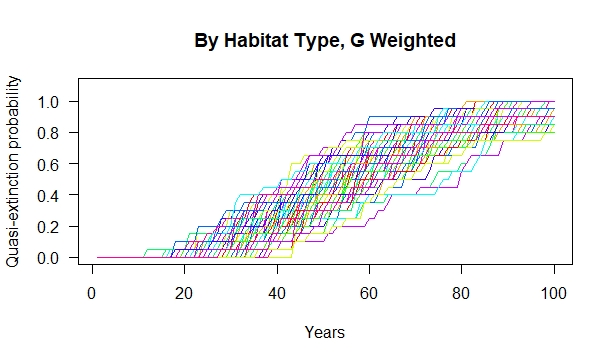
The figure below represents 100 "random walks" calculating "quasi-extinction" probability over time. Quasi-extinction is a time at which the species goes below the minimum population size it would need in order to persist, which in this case I arbitrarily estimated to be 100 individuals. "G Weighted" is a reference to the most robust subpopulation. A lot of the projections I am running do not bode well for the species. As you can see, at best this set of parameters gives even the most beneficial habitat only a 20% chance a century from now. This is a model developed with climate change effects added, such as increased max and min temps annually and reduced winter precipitation, which is the strongest predictor for establishment of new plants.
Most of the analysis that is cross validated and tested iteratively all points to Mammillaria halei being more vulnerable that I had thought it would be. I'll be interested to see what the next chapter, on species distribution modeling, reveals. I am also investigating why it is that a lot of these extinction risk modeling techniques seem biased toward dire predictions. I think it's something a well versed statistician could explain to me. I bet it has to do with the sensitivity of these models to very small changes in initial conditions, and the high variance of small data sets. I know in my bones that Mammillaria halei is more resilient than my models are showing, but I can't find a quantitative justification for changing the model parameters. I am going to try generalized linear models of the count data using a Poisson family regression, or negative binomial if it's a better fit, and then generating a pseudo-count data set of, maybe, 100 years of counts, and then try the modeling using that, just to see if that process flattens out some of the noise. I think a great deal of the apparent fate of the species is a result of error structure in the data, rather than real threats. In other news, I am chronically unhappy the majority of the time, without regard to most efforts to ameliorate the condition. The work is a balm by comparison. I'm glad to be going to a few meetings a week, meditating, plugging away at being on the planet, one day at a time. But I find myself thinking about an escape more often than I would prefer. I had dinner with an old recovery friend last night who is visiting Phoenix from Santa Fe, and of course the first thing out of his mouth when I asked how he was doing was "I have prostate cancer and it's spread to my hip bones so the doc gives me about 2 years. I'm okay with it, I just don't want to suffer." He then related a story where, a couple days after the diagnosis, he was walking late at night in Albuquerque and a car drove by and slowed and a kid pointed a gun out the window at him. He stopped and stood there and the car slowly drove on, the kids inside laughing. He said the first thought that crossed his mind was "go ahead, shoot. Shoot!" He found himself extremely angry when they drove away. It was a good conversation as we could compare notes on a lot of these impulses and perspectives. We then went to a speaker meeting that was okay, although in the light of day today I suddenly have deep, deep reservations about it. Maybe I'll write about that later. Right now, it's a lovely soft day out, cool and raining, a soaking winter type rain. I look forward to going back to sleep later. The cacti aren't too sure.